threading days of movement and stillness
A simple tool to support your daily practice of movement and stillness. Starting a new practice is rarely a problem. It is the continuation that is challenging – and where the most profound benefits are found.
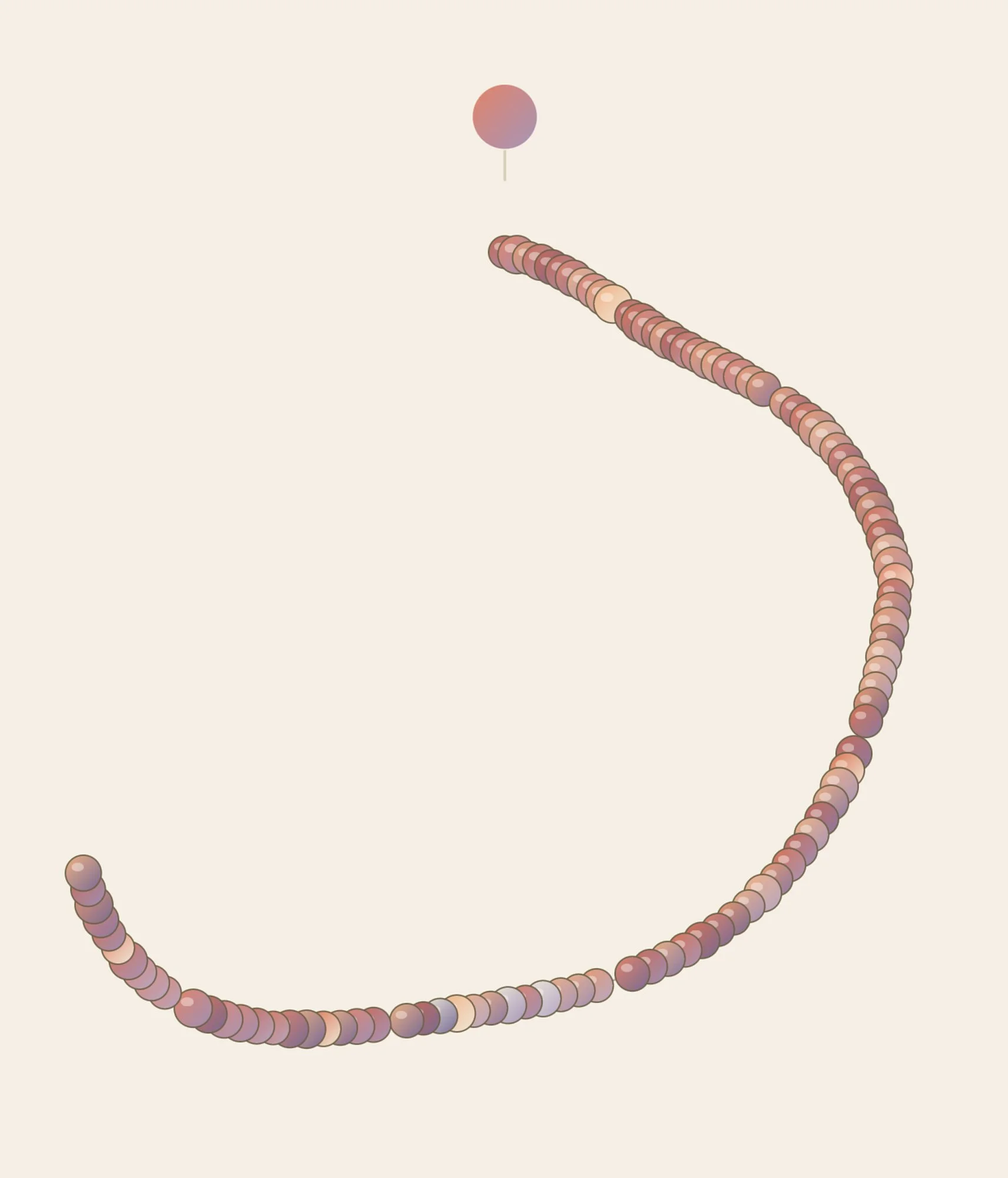
About threading days of movement and stillness
How to begin
Open the page once, then bookmark it or add it to your phone's home screen — there's nothing to install and nothing to log in to.
Each day one bead can be added. Click the buttons under the drawing when you have moved, and/or for practiced stillness — meditation or pranayama. Add one and the bead takes on a single colour. Add both and it comes alive as two colors meet. There are 108 beads in a cycle, the same as a mala [string of beads] you'd hold in your hand.
Many people find sunrise and dusk useful time anchors to practice— once as the day opens, once before it closes. It’s up to you what you do when, and what kind of practice you do.
Choose one device (like your mobile, tablet or computer) to draw your beads on. The page only remembers where you are when you use it every time on the same device.
That's the whole tool. No streaks to protect, no competition — the thread simply shows you where you've been. When the thread is complete, you can save it and start a new cycle.
Available soon
Leave your details below to find out when it’s ready
Why continuity is the hard part
Starting a daily practice is rarely the problem. Most people can commit to a week, even a month, on willpower alone. What's hard is the stretch after that, once the practice stops feeling new, the reasons for doing it feel less urgent, or most often, when the busyness of life starts to take over again.
However daily practice of both movement (yoga, exercise, walking) and stillness (meditation, pranayama, ritual) is actually where the most benefit, or medicine, can be found. Our body and mind function best with a reliable rhythm and shorter daily sessions rather than long ones spread further apart.
Threading a bead each day, showing you the shape of your own continuity, one small object at a time. This tool is an attempt to bring that quality onto your screen — something to look at, not something to manage.
108 beads
Malas have carried 108 beads for a very long time. The number 108 shows up across several traditions with different roots of thought:
Language. The Sanskrit alphabet is traditionally counted as 54 letters, each said to carry both masculine and feminine quality — 54 times 2.
Sky. Vedic astronomers noted long before modern measurement confirmed it, the distance from the Earth to the Sun is roughly 108 times the Sun's diameter, and the distance from the Earth to the Moon is roughly 108 times the Moon's diameter.
Breath. Some yogic texts describe a day as containing roughly 21,600 breaths, and treat 108 as a meaningful fraction of that cycle — a number small enough to count, large enough to represent the whole.
Self. In Buddhist tradition, 108 is the number of kleshas, or afflictions, said to stand between a person and clarity — with each bead marking one released.
Chart. In Vedic astrology, 12 houses multiplied by 9 planets makes 108.
None of these fully explains the others, yet cultures that never spoke to one another kept arriving at the same number from different directions — the sky, language, the body, the breath. Counting to 108 is less a rule than an inheritance.