T H E · B E S T · M E D I C I N E ?
Nature is bursting with flower buds and bird song. Social media is bursting with invitations to join the next great fast. But fasting from what exactly?
article written by Eva Dusch (āyurveda & jyotiṣa)

[…]
Spring, in particular, is often considered a good time to fast…
In the Vedas, fasting was never ‘a big thing’ that had to be announced. It was always a common practice, undertaken for different reasons, like noticing, participating in, and praising the grander cycles and rhythms that hold us and are happening through us.
Jyotish and especially Āyurveda have used fasting as medicine and therapy for thousands of years. It is also often considered the first line of treatment when appropriate for the person and situation. It’s not about adding or doing more, but moving towards less. If nothing at all.
As Dr Claudia Welch beautifully puts it: 'The first medicine I look to is what can be taken away that's hurting me on any level? Rather than focusing on what we have to purchase, make, buy and do, to add something to our life. Whether that's a new routine, diet, meditation, or movement.'
The physical level
From the perspective of Āyurveda, the first goal of fasting is not about aesthetics or weight loss. It’s to rekindle agni, to improve your digestive fire. It’s defined as “complete voluntary abstinence from taking any kind of food for a particular time, in order to give rest to the digestive system” (Mangalagowri V. Rao, 2016). It gives rest to the stomach, intestines and digestive organs. It cleanses and rejuvenates the body and removes blockages and metabolic residues (ama).
Fasting falls under one of the many langhana therapies, which are reducing or depleting in nature and are meant to produce lightness in the body. Many imbalances and diseases are reduced or disappear just by fasting because ama is often the cause of imbalances and disease. One of the first examples given in the texts is fasting in the case of a beginning or upcoming fever (JwaraRoga). Stop eating and see how much quicker the body is able to reset itself.
Even more fundamental is the concept of time (kala), which teaches that fasting can be especially beneficial during seasonal transitions, helping us align with nature’s rhythms. As the external environment shifts, so too does our internal climate. These changes are reflected in our doshas—vata, pitta, and kapha—the energies that govern our bodily functions. To stay in tune with nature and support this realignment, practices such as fasting, dietary adjustments, and the use of specific herbs serve as a vehicle.
Hence, fasting is not something to be practised only in times of urgency or when social media tells us so. Rather, it is a form of preventive medicine—creating space for the body to function naturally again. It is a step toward restoring the intelligence of the Self. Yet Ayurveda has always emphasised that it must be practised with wisdom, at the right time and in the right way for each individual.
But here’s the thing: fasting is not merely a physical act of restriction.
We have come to see fasting as a purely physical act, while its roots are deeply spiritual, even karmic. It is far more than simply denying yourself that cup of coffee or a cardamom bun from your favourite bakery and observing how your body and mind respond.
In traditions like Jyotish, fasting is considered a powerful remedy for human suffering. One of the many things I’ve learned over the years is that fasting on specific days of the week can help reduce karmas associated with particular planets that may be influencing the challenges in your life. In this way, you begin to ‘burn’ karmas rather than food.
This can relate to many areas of life—relationship or marriage difficulties, recurring health issues, or challenges in finding or keeping a job. Ultimately, it depends on what you seek to address and what is appropriate according to your birth chart.
And that brings me to the true nature of fasting…
It is considered part of Daivavyapashraya (spiritual) therapies. The Sanskrit word for fasting, upavāsa, literally means ‘to live close to oneself’ or ‘to sit or stay near the Divine.’ It is an invitation to return inward; to remain close to yourself until you rediscover that inner sense of bliss.
True fasting goes above and beyond simply abstaining from food. It is the practice of letting go of desires, offering them up in a spirit of prayer. It is about giving the body, mind, and senses a break from constant stimulation and distraction. In doing so, it helps cultivate mastery over the senses and brings a sense of calm and clarity to the mind.
Fasting can also support the release of emotions such as anger, greed, jealousy, and grief—allowing us to process what remains unresolved or undigested within. If you try going a day without food, you may first notice a surge of mental chatter, even restlessness or nervousness—like milk being churned, bringing froth to the surface. But as this settles, it can give space for clarity and peace, along with strengthened willpower and improved concentration (though this is surely not a given, as it must be seen through the lens of one’s personal constitution).
So it made me wonder: are we really fasting?
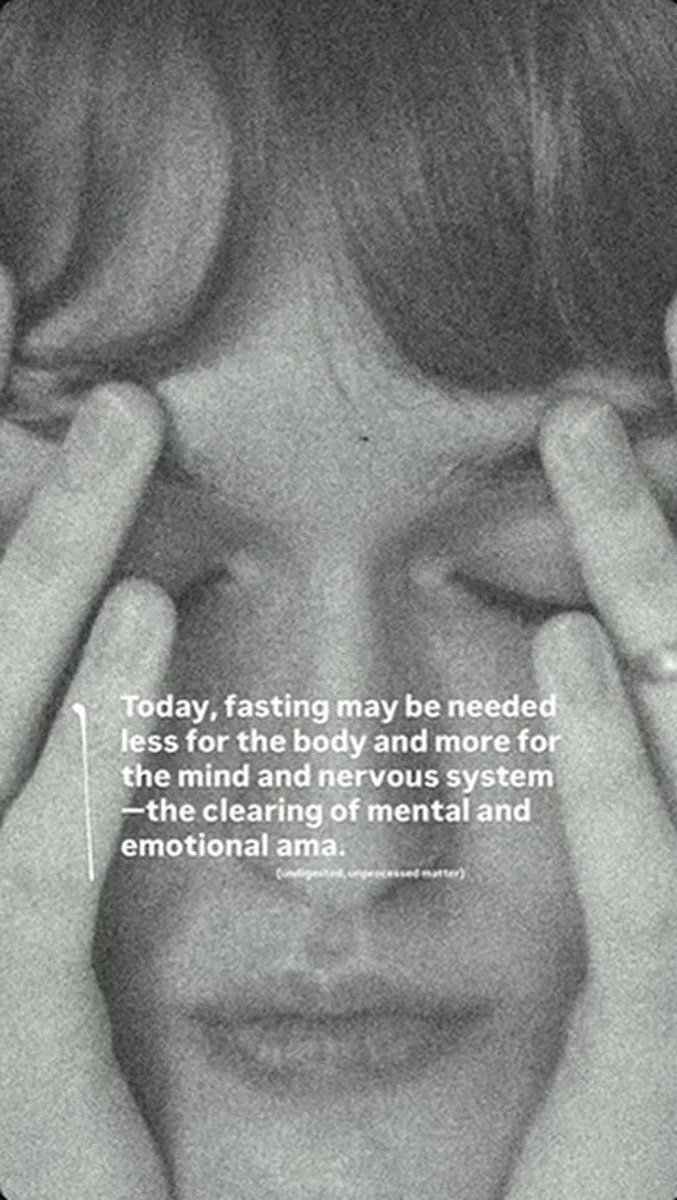
What is the value of denying ourselves food while continuing to overstimulate in so many other ways—through constant streams of social content, or by distracting ourselves with endless sounds and images? Today, fasting may be needed less for the body and more for the mind and nervous system—the clearing of mental ama.
One of the key teachings of Āyurveda is that everything we take in through our senses must also be digested. What we see, hear, feel, and absorb all need to pass through a process of transformation. How smoothly this occurs depends on our constitution, our state of balance or imbalance, and above all, the strength of our Agni—our digestive capacity.
In that light, it’s helpful to ask yourself what kind of fast is truly needed. What is needed for body, mind and spirit? And when we choose to fast, can we make that one moment, day, or week of fasting a true act of subtraction? Can we reduce our use of social media, schedule fewer meetings or social events, and spend more time in silence or a natural environment?
How can we create genuine space and rest for the whole system?
We can fast in many ways, not only from food:
Talking (or gossiping)
Technology
Opinions
Music
Fasting from TV, Netflix, podcasts etc. Instead, we can feast on the wisdom and beauty of nature by visiting new waterholes, going for hikes, or simply walking around the neighbourhood with no headphones in and paying sweet attention to what is happening in the present moment. Or maybe it’s feasting on intimacy in your relationships, or quality time with the ones you love.
Fasting from sleeping in and feasting on aligning yourself with the rhythms of nature, connecting with the energy of the rising sun, and possibly trying to comprehend how the whole universe is moving within itself.
Fasting from criticism, judgment, or bitching, and feasting on giving compliments to anyone or everyone!
words and images: Eva Dusch. For more of Eva’s articles go here