“I felt truly present” · the senses as doorways
“The body is never rigidly enclosed, never a protected entity. It displaces and shifts in the infrastructures of our times, like a wayfarer on the journey.”
“I felt truly present.” These words instil a memory and longing for a time where there is a felt quality of simplicity and intention. Often we remember this from childhood, when being fully present was all we did. A child is mostly naturally in rhythm with nature and their own needs — to play, eat, digest and rest. Now, when do we feel truly present? Is there something standing in its way?
Through every waking moment — and many sleeping ones — the world arrives: as sound, as texture, as light, as taste, as scent. We receive it constantly, often without noticing. And yet the quality of that receiving matters enormously. We are always in exchange with the world around us. Ayurveda has a detailed philosophy on our perception, starting with the sense organs — the Indriya.
The organs of knowing and doing
The Indriyas are divided into two groups. The first are the five cognitive sense organs — in Sanskrit, Jnanendriyas, meaning wisdom-collecting senses: ears, skin, eyes, tongue and nose. Each is paired with one of the five elements and its subtle counterpart. The ears receive sound, linked to space. The skin receives touch, linked to air. The eyes receive form and light, linked to fire. The tongue receives taste, linked to water. The nose receives scent, linked to earth.
Alongside these are the five motor organs — Karmendriyas — through which we act upon the world: hands, feet, mouth, and the organs of reproduction and elimination. Our hands, for instance, are the motor organ of touch. Linked to the skin, to air, to movement — and through all of these, to vata dosha. It is a beautifully concise system which in Ayurveda we use to think about both health and its disturbance.
Perception is an active process
What makes this framework particularly interesting is that Ayurveda does not treat sensory perception as passive. The senses do not simply register what is there. Perception is governed by prana vayu — the inward-moving force of vata — which receives sensory information, integrates it, and initiates a response. The sense organs are the doorways; prana vayu is what moves through them.
This means the quality of perception depends on the quality of the instrument. When prana vayu is balanced and the sense organs are clear and rested, we perceive with acuity. When the senses are overloaded, depleted or imbalanced, what we receive becomes distorted — and so does our response to it.
The mind, too, plays a central role. In Ayurveda, Manas — the mind — functions as a sixth sense organ, the one that processes and integrates what the other five receive. It does so through Manovaha Srotas, the channel of the mind, which is intimately connected to our nervous tissue (Majja Dhatu). When this channel flows freely, perception is sharp and responsive. When it is congested or overwhelmed, even clear sensory input may not be properly received.
The Charaka Samhita, one of the foundational classical texts of Ayurveda, names unwholesome contact between the sense organs and their objects as one of the root causes of disease. Too much, too little, or the wrong kind of sensory experience — all of these disturb the system over time.
Tending to the senses
This is why the senses receive dedicated attention in Ayurvedic practice — not as an afterthought, but as a foundation.
Dinacharya, the daily routine, includes practices specifically designed to maintain sensory clarity. Tongue scraping, for instance — one of the most familiar — clears accumulated residue from the tongue each morning, sharpening the sense of taste and stimulating digestion. These practices are ways of tending to the instruments of perception so that they remain open, clear and responsive.
Specialised treatments work at this level too. Karna poorana — warm oil held in the ears — nourishes the space element and the hearing faculty. Abhyanga, full-body oil massage, works directly through the skin, the organ of touch, addressing vata through its own element. And Shirodhara, the steady flow of warm oil across the forehead, works more deeply still — calming the nervous system, allowing the senses to settle into a rare and profound quiet.
Presence as practice
To tend to the senses in Ayurveda is to tend to the quality of our contact with the world. It is to recognise that how we perceive shapes how we feel, think and respond — and that this is something we can actively care for.
These precious organs benefit from both rest and nourishment — moments of silence and stillness, but also the regular lubrication and care that keeps them vital.
Nature is medicine for the senses. A walk outside calms and nourishes them on multiple levels at once. So does resisting the urge to multitask, or to constantly check in on all available information channels.
More and more, we can choose to drive without a podcast, to cook in silence, to wait without reaching for our phones. Small choices that return us to presence — and keep our delicate nervous system, and the senses it serves, in balance.
Image footnote:
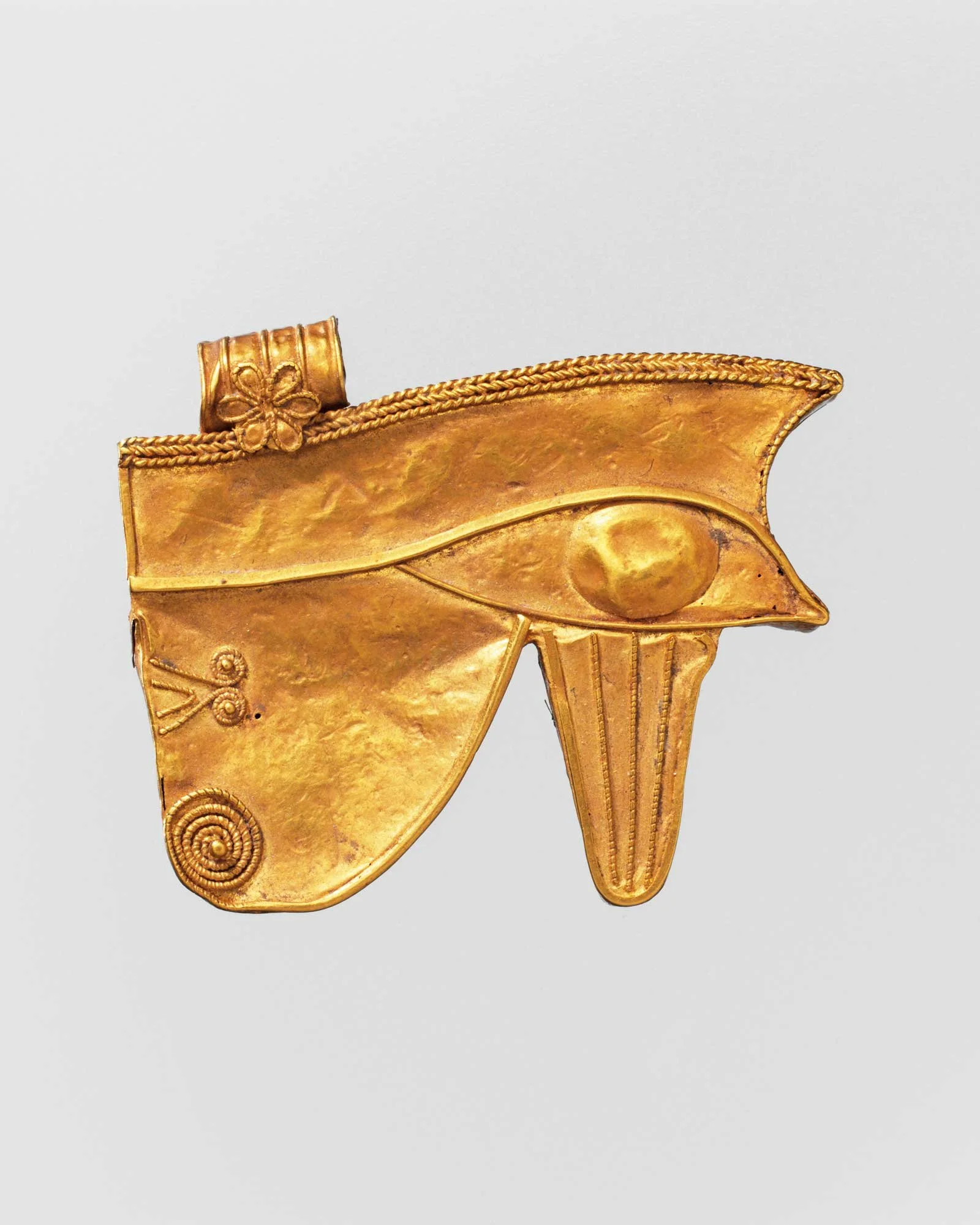
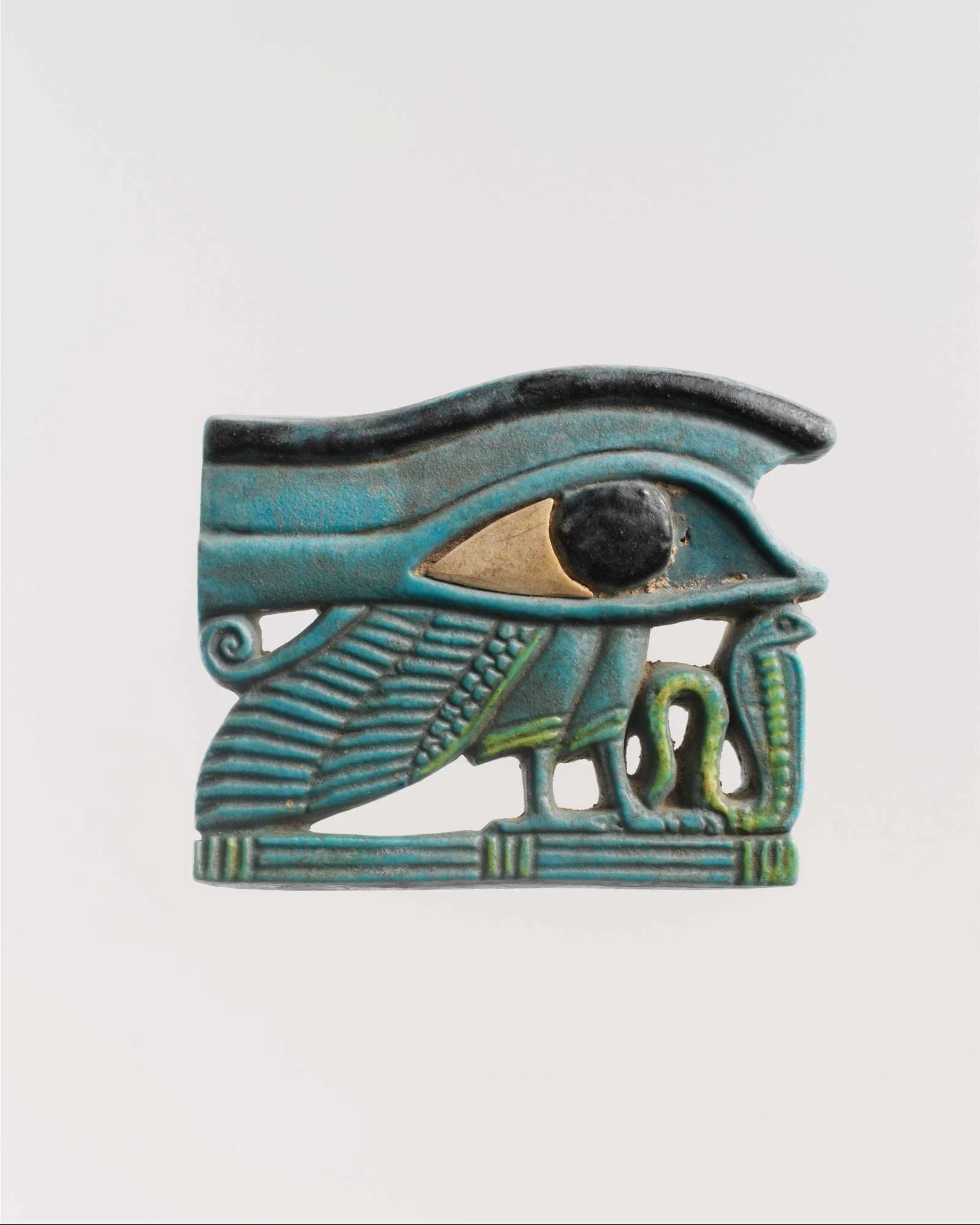
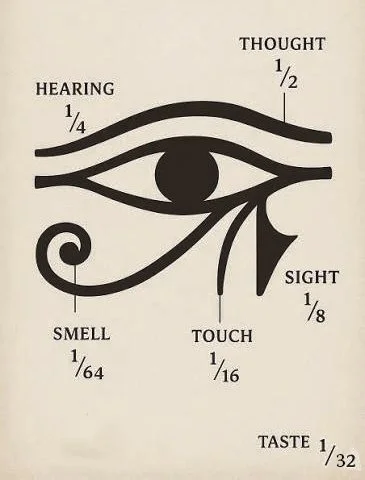
The Eye of Horus — an ancient Egyptian symbol— represents restored sight and the protection of perception. Its story is one of healing: an eye lost, then made whole again. What makes this symbol even more remarkable is that each part of the eye corresponds to one of the six senses: hearing, thought, sight, touch, smell and taste — each carrying a fractional value. Together they add up to 63/64. The missing fraction is said to represent what cannot be measured or named.
Ayurveda shares this understanding. The five sense organs plus manas — the mind as sixth sense — form the complete picture of perception. Some things are understood across all traditions: that to perceive clearly is a gift, and that this gift requires care.
Image 1: Wedjat Eye Amulet, 332–30 BCE; The Metropolitan Museum of Art, photo by Peter Zeray
Image 2: Wedjat Eye Amulet with a wing and other elements, ca. 1070–664 BCE; The Metropolitan Museum of Art, photo by Peter Zeray
Image 3: Eye of Horus digital drawing; from internet; with corrected numbers
Opening citation:
These sentences form the end note of a text by art curator Jennifer Teets. In this text she writes about the personal correspondence with her mentor, sociologist and philosopher Bruno Latour, who just passed away. They helped me connect the practice of medicine (which is relatively new to me) to my work in art.
“Envelopes, spheres, skins, ambiances, were things that he [Bruno Latour] was trying to dig out of totally inaccessible infrastructures. These are the real ‘conditions of possibility’, he would write to me in our epistolary exchanges. “You are on life support, it’s fragile, it’s technical, it’s public, it’s political, it could break down—it is breaking down—it’s being fixed, you are not too confident of those who fix it.” Mousse Magazine 20.10.22, online